The Rising Role of Energy Storage in PV
Over the past decade, photovoltaic (PV) power has emerged as one of the most standout industries in the global energy transition. Driven by technological advances and large-scale production, the cost of PV power generation has kept declining. In many countries and regions, PV has become the most cost-effective option for new power capacity additions. According to the International Energy Agency (IEA), global newly installed PV capacity maintained steady growth in 2025, making PV the leading source of newly commissioned power generation worldwide.
Against the robust expansion of the PV sector, a new term has come to dominate industry exhibitions, policy documents and investment reports: energy storage.
Energy storage and PV integration has become a universal topic among enterprises at major global events, including SNEC in Shanghai, Intersolar Europe in Munich and other international new energy expos. Why has energy storage gained such unprecedented prominence?
It is not because energy storage is a brand-new technology, but because the new energy industry has entered a new development phase. As PV installed capacity continues to expand, the industry focus has shifted from how to generate more electricity to how to make better use of electricity — and energy storage is the core solution to this challenge.
Booming PV Deployment Brings New Challenges to Energy Systems
PV power boasts outstanding advantages of being clean, low-carbon and cost-competitive, yet it has an inherent limitation: its power output is intermittent and volatile.
PV systems generate electricity during daylight hours and stop producing power after sunset; output surges on sunny days and drops sharply on cloudy days. This means PV generation cannot fully align with actual power demand.
When the penetration rate of new energy was relatively low, this issue remained negligible, as power grids could rely on conventional power sources such as thermal, hydropower and gas-fired plants to balance power supply and demand. However, as new energy accounts for a larger share of the power mix, the challenges have become increasingly prominent.
A typical example is the Duck Curve. PV output peaks sharply at noon, leading to excess power supply, while solar generation drops rapidly in the evening. This coincides with the peak power demand from residential and industrial users, creating a severe mismatch between power supply and demand across numerous countries.
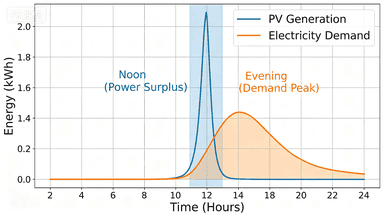
The higher the share of renewable energy in the power system, the greater the demand for flexible regulation resources.
The IEA forecasts that to triple the global installed capacity of renewable energy by 2030, the total installed capacity of energy storage worldwide will need to grow approximately six times from current levels to over 1,500 GW. This clearly indicates that the core challenge for future new energy development lies no longer in expanding power generation capacity, but in enhancing power regulation capability — and energy storage stands out as the most direct and effective technological solution.
Energy Storage Transforms PV from Weather-Dependent Generation to On-Demand Power Supply
Essentially, energy storage endows electricity with time value.
In traditional power systems, large-scale electricity storage was hardly feasible, meaning power generation and consumption had to happen simultaneously. Energy storage systems have completely changed this operating logic.
Excess electricity generated by PV systems during peak sunlight hours can be stored and discharged when solar output falls short or electricity prices rise. This simple mechanism revolutionizes the operation of new energy systems.
For residential users, energy storage raises the self-consumption rate of on-site PV power and reduces reliance on grid electricity.
For industrial and commercial users, it enables peak-valley arbitrage, cuts overall electricity costs and lowers demand charges.
For large-scale ground-mounted PV power stations, energy storage smooths power generation curves, improves grid absorption capacity and curtails PV power curtailment.
For power grids, energy storage delivers multiple critical services including peak shaving, frequency regulation and backup capacity, strengthening the overall stability and security of power systems.
In short, energy storage upgrades PV facilities from standalone power generators to integrated energy management systems, reshaping the entire development logic of the new energy sector.
The Energy Storage Market Enters a High-Speed Growth Phase
Market figures speak volumes. According to IEA data, newly installed global battery energy storage capacity reached around 108 GW in 2025, representing a year-on-year increase of over 40%. Compared with 2021, annual new energy storage capacity has surged more than tenfold, making energy storage one of the fastest-growing segments across the global energy industry.
Major markets around the world are accelerating the deployment of energy storage. China has retained its position as the world’s largest market for newly commissioned energy storage for consecutive years. In Europe, volatile energy prices and power market reforms have driven strong demand for residential and commercial & industrial energy storage. The United States has seen rapid development of large-scale energy storage projects supported by tax incentive policies. Emerging markets across the Middle East, Australia, Latin America and other regions are also rolling out energy storage facilities on a large scale.
A clear global trend has taken shape:
Traditional new energy projects used to be purely PV-based, while future projects will increasingly adopt a PV + Energy Storage model. Energy storage is evolving from an optional add-on to a standard configuration.
Power Market Reforms Unleash the Full Value of Energy Storage
While technological advancements have made energy storage technically viable, power market reforms have unlocked its economic value.
In the past, many regions adopted flat electricity tariffs with little price difference between day and night, leaving limited profit potential for energy storage. With the deepening of power market reforms, an increasing number of countries have introduced time-of-use tariffs, real-time pricing and dynamic pricing mechanisms, under which the value of electricity varies drastically across different time periods.
For instance, electricity prices tend to drop during midday when PV generation is abundant, while soaring multiple times during evening peak demand hours. Energy storage allows operators to purchase and store electricity at low prices and sell or consume stored power at high prices, realizing the reallocation of electricity value.
This business model has delivered tangible economic benefits for industrial and commercial users.
Accordingly, energy storage is transforming from a pure capital expenditure into a revenue-generating energy asset. As power markets mature further, energy storage will embrace an even more diverse range of business models in the future.
Falling Battery Costs Drive Widespread Adoption of Energy Storage
The large-scale application of any energy technology hinges on cost reduction, and energy storage is no exception.
Over the past decade, the lithium-ion battery industry has developed rapidly. Fueled by the expansion of the new energy vehicle supply chain, scaled manufacturing and technological innovation, battery costs have plummeted by more than 90% compared with 2010. Meanwhile, energy storage batteries have achieved higher energy density, longer cycle life and substantially improved safety performance. Lower costs and better performance have shortened the payback period of energy storage projects. A growing number of users recognize that energy storage can not only boost energy efficiency but also generate solid economic returns.
In the long run, energy storage is following a development path similar to the PV industry:
Technological progress drives cost reductions; lower costs expand market demand; and market expansion further fuels technological upgrading. This virtuous cycle is gaining momentum at an accelerating pace.
Industrial Competition Shifts from Hardware Sales to Comprehensive Solutions
Energy storage has drawn widespread attention also because it is reshaping the entire new energy industrial chain.
In the past, industrial competition mainly focused on module power output, conversion efficiency and unit watt cost. Enterprises competed to generate more power and offer products at lower prices. As the market matures, however, improvements in standalone hardware performance can no longer create distinct competitive edges.
Customers now prioritize overall operational benefits. They care less about incremental gains in module efficiency, and more about practical outcomes:
Whether the overall system yields higher power generation;
Whether electricity expenses can be reduced;
Whether the investment payback period can be shortened;
Whether power supply remains stable and reliable.
Against this backdrop, a growing number of enterprises are transforming from product suppliers to comprehensive energy solution providers. Inverter manufacturers have expanded into energy storage; PV module suppliers have launched integrated PV and energy storage products; mounting system producers have optimized products for combined PV-storage scenarios; EPC contractors deliver one-stop integrated energy solutions; and software platform operators leverage energy management systems to maximize operational returns. The focus of industrial competition has shifted from individual equipment performance to overall system value.
PV-Storage Integration to Become the Standard Model for Future Energy Systems
Looking back over the past decade, the PV industry focused on delivering low-cost power generation. Over the next decade, the new energy sector will center on achieving highly efficient power utilization.
As the penetration rate of new energy continues to rise globally, the strategic importance of energy storage will become even more prominent. The IEA projects that the global energy storage market will maintain robust growth through around 2030. Countries worldwide are incorporating energy storage into national energy strategies, and investment institutions regard it as one of the most promising tracks within the new energy sector.
It is foreseeable that the future energy system will follow a clear framework:
PV generates clean green power; energy storage manages green power; digital systems optimize the operation of green power.
The three pillars will form the core architecture of next-generation energy systems.
Conclusion
Energy storage has emerged as a hot topic in the PV industry not because it is a new concept, but because it addresses the core contradictions constraining the development of new energy.
With the continuous growth of PV installed capacity, industrial competition is no longer limited to power generation capacity, but extends to energy utilization efficiency and value creation capabilities. Energy storage acts as a vital bridge connecting power generation sides, power grids and end users, helping boost the consumption of new energy, enhance grid stability, cut users’ electricity costs and raise project investment returns.
The milestone of over 100 GW in newly installed global energy storage capacity in 2025 marks not only a booming market, but also a profound shift in the development logic of the energy industry. In the future, energy competition will no longer be a race to produce more green electricity, but a contest to maximize the value of every kilowatt-hour of green power — and energy storage is the key to achieving this goal.
PV creates green energy, while energy storage unlocks its full value. The future of the energy system does not lie in choosing between PV and energy storage, but in realizing deeper and more efficient collaboration between the two.