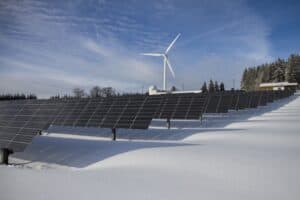
Agrivoltaics or Agri-PV is emerging as an important approach to combining renewable energy generation with agricultural production. By installing solar PV systems on agricultural land while maintaining farming activities, agrivoltaics can create new opportunities for both farmers and the energy sector.
Switzerland has considerable potential for this technology. However, despite its strong solar ambitions, the development of agrivoltaics remains at an early stage. Regulatory requirements, project economics and administrative complexity continue to limit the number of projects being developed.
Switzerland Has Significant Agri-PV Potential
Solar energy is expected to play an increasingly important role in Switzerland’s transition toward renewable energy. According to a recent report from the Zurich University of Applied Sciences (ZHAW), the theoretical annual electricity generation potential of agrivoltaic systems in Switzerland could reach approximately 323 TWh.
Even when the analysis is limited to agricultural areas located within 300 meters of a grid connection point, the theoretical potential remains around 113 TWh per year.
These figures demonstrate that agrivoltaics could make a meaningful contribution to Switzerland’s future energy supply. However, the ZHAW study also emphasizes that these figures represent a theoretical maximum. The practical potential will depend on agricultural conditions, regulations, grid availability and the suitability of individual sites.
For this reason, Agri-PV should not be viewed as a replacement for rooftop solar or other existing PV applications. Instead, it can complement them by opening additional opportunities for solar generation.
Why Is Agrivoltaics Developing Slowly?
Despite the potential, agrivoltaic installations currently account for only a very small share of Switzerland’s solar market.
One of the main challenges is the country’s regulatory framework. Solar installations on agricultural land must meet specific requirements concerning agricultural production and land use. In particular, projects need to demonstrate that solar generation does not significantly interfere with farming activities.
Land ownership can also create additional challenges. Around half of Switzerland’s agricultural land is leased, meaning that developers may need to coordinate with farmers, landowners, local authorities and other stakeholders before a project can move forward.
Economic uncertainty is another important factor. Agrivoltaic projects can require more specialized planning and construction than conventional ground-mounted PV systems. Developers need to balance electricity generation with agricultural requirements, while also considering project costs, permitting and long-term returns.
Mounting Systems Are an Important Part of the Solution
The development of agrivoltaics also creates new requirements for solar mounting systems.
Unlike conventional ground-mounted PV projects, Agri-PV systems need to coexist with agricultural operations. The structure may need to provide sufficient clearance for machinery, allow access for maintenance and harvesting, and adapt to different crops and farming methods.
Structural design is equally important. Depending on the location, agrivoltaic systems may need to withstand snow loads, wind loads and other local environmental conditions while maintaining the required height and spacing.
This makes flexibility an increasingly important characteristic of Agri-PV mounting solutions.
For mounting system manufacturers, the challenge is therefore not simply to support solar modules. A successful Agri-PV solution needs to consider the complete site — including agricultural operations, structural requirements, installation efficiency and long-term maintenance.
Lessons From Other European Markets
Switzerland can also learn from neighboring European countries.
Germany, France, Italy and Austria have moved further in developing agrivoltaic projects and regulatory frameworks. Their experience provides useful examples of how permitting procedures, financial support and agricultural policies can influence market development.
Local participation could also help improve project acceptance. Cooperation between farmers, local communities, energy cooperatives and project developers may create additional opportunities for successful Agri-PV projects.
What Does the Future Hold?
The future of agrivoltaics in Switzerland will depend on more than the availability of suitable land or solar technology.
Clearer regulations, predictable investment conditions and practical project-development frameworks will be essential. At the same time, technological solutions will need to become increasingly adaptable to different agricultural environments.
For the solar industry, this represents an important opportunity.
As land availability becomes a greater consideration in renewable energy development, combining agriculture and solar generation could become an increasingly attractive approach. Well-designed agrivoltaic systems can potentially generate clean electricity while allowing agricultural activities to continue.
For solar developers, EPC companies and mounting system suppliers, this creates demand for solutions that are structurally reliable, installation-friendly and adaptable to different agricultural requirements.
Switzerland may still be at the beginning of its Agri-PV journey, but its significant theoretical potential suggests that the market deserves close attention.
The next stage of development will depend on whether policymakers, farmers, developers and technology providers can work together to turn this potential into practical, economically viable projects.
Source: pv magazine